Helping You Grow with Tech & Marketing


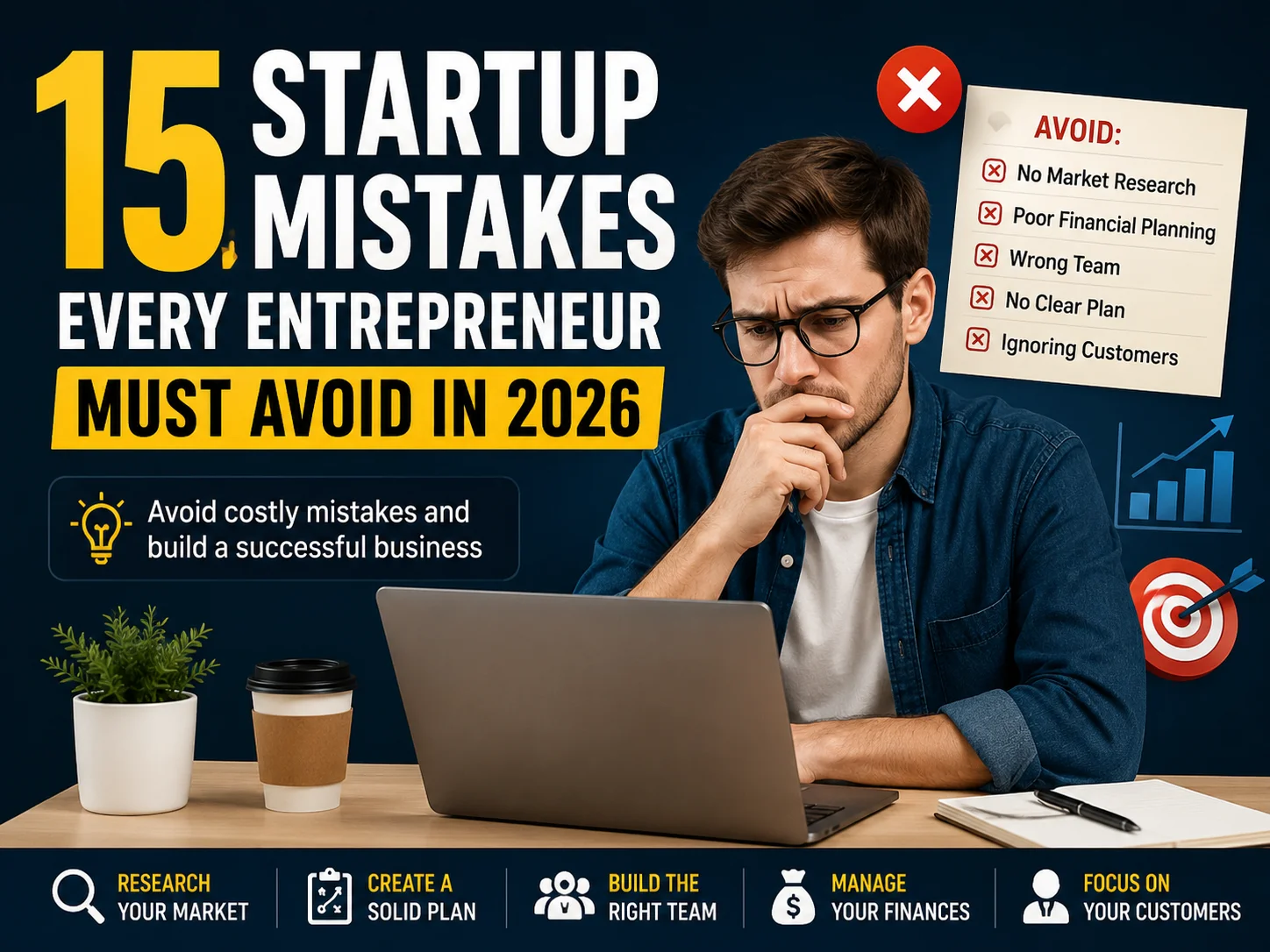
Quick answer: The most dangerous startup mistakes in 2026 are building before validating demand, ignoring cash flow, scaling prematurely, and avoiding co-founder conversations until it’s too late. Harvard Business School Professor Tom Eisenmann — whose research spans hundreds of real failed companies — identifies these four as the core structural causes of startup mistakes, and every one of them is avoidable with the right habits in place early.
Quick summary: Nine out of ten startups fail, and research from Harvard Business Review, Forbes, and Entrepreneur consistently shows that most of those failures trace back to the same predictable, avoidable startup mistakes made in the first 12 to 18 months. This guide breaks down the 15 most damaging startup mistakes entrepreneurs make in 2026, why each one happens, how it leads to failure, and exactly what to do instead — backed by data, real founder examples, and expert insight.
Key Takeaways
- 90% of startups fail — and most trace back to repeatable, avoidable startup mistakes, not bad luck (Forbes, 2026)
- 42% of startups fail because they build a product nobody wants (CB Insights, via Parriva)
- 65% of high-potential startups fail due to co-founder conflict, according to HBS Professor Noam Wasserman (Entrepreneur, 2025)
- Entrepreneurs who write a business plan are 16% more likely to succeed (Harvard Business Review, via Parriva)
- U.S. startup mistakes increased 60% in a single recent year — competition has never been harder (HBR, 2025)
Table of Contents
- Introduction: Why So Many Startups Fail in 2026
- The Real Data Behind Startup mistakes
- Startup Mistake #1 — Building Without Validating Demand
- Startup Mistake #2 — Skipping the Business Plan
- Startup Mistake #3 — Running Out of Cash
- Startup Mistake #4 — Scaling Too Early
- Startup Mistake #5 — Co-founder Conflict Left Unaddressed
- Startup Mistake #6 — Skipping Market Research
- Startup Mistake #7 — Treating Marketing as an Afterthought
- Startup Mistake #8 — Hiring Too Fast
- Startup Mistake #9 — Spreading Too Thin
- Startup Mistake #10 — Refusing to Adapt
- Startup Mistake #11 — Mixing Personal and Business Finances
- Startup Mistake #12 — Ignoring Legal Setup
- Startup Mistake #13 — Chasing Vanity Metrics
- Startup Mistake #14 — Taking Advice From the Wrong People
- Startup Mistake #15 — Quitting Before Traction Arrives
- What Real Founders on Reddit Say About Startup Mistakes
- Startup Mistakes Checklist: Audit Your Business Right Now
- Frequently Asked Questions
- Final Thoughts
1. Introduction: Why So Many Startups Fail in 2026

Here’s the uncomfortable truth nobody tells you when you register your first business: the hard part isn’t starting. It’s surviving the first 18 months without making the same startup mistakes that have quietly killed thousands of ventures before yours.
In 2026, launching a startup mistakes has never been easier. You can register a business, build a website, and publish a product in a single afternoon. The tools are better, the information is more accessible, and AI has removed barriers that used to require entire teams. And yet — the failure rate hasn’t budged. Nine out of ten startups still fail (imFounder, 2026).
That gap between “easier to start” and “still failing at the same rate” is explained by one thing: the startup mistakes that matter most aren’t technical. They’re strategic, financial, and human — and they don’t care how sophisticated your tools are.
The good news? Every single mistake in this guide is documented, studied, and described in detail by some of the world’s most respected business researchers. You don’t have to learn them the hard way. You just have to be willing to read about them before they happen to you.
2. The Real Data Behind Startup Failure

Before we get into individual startup mistakes, let’s look at the numbers that frame everything else.
According to the U.S. Bureau of Labor Statistics, 2 out of 10 businesses fail in their first year alone (US Chamber of Commerce, 2026). That number rises to roughly 5 in 10 by year five, and about 7 in 10 by year ten. Recent data from Harvard Business Review shows that U.S. startup mistakes increased by 60% in a single recent year — a sobering reminder that better tools don’t automatically mean better outcomes (HBR, 2025).
The causes are well-documented:
- 42% of startups fail because there’s no real market need for what they built (CB Insights, via Parriva)
- 82% of startup mistakes are linked to cash flow issues that were visible in the original financial projections but ignored (GrowthGrid, 2026)
- 65% of high-potential startups fail due to co-founder conflict (HBS Professor Noam Wasserman, via Entrepreneur, 2025)
Notice what’s not on that list: bad timing, bad luck, or an unfair market. These startup mistakes are structural — which means they’re correctable if you know what to look for.
3. Startup Mistake #1 — Building Without Validating Demand

If there’s one startup mistake that deserves to be at the top of every list, it’s this one. Building a product before confirming people actually want it is the single most common, most expensive, and most avoidable reason startups fail.
CB Insights found that 42% of startups fail because they built something nobody needed. Nearly half of all startup deaths — preventable, with a handful of customer conversations (CB Insights, via Parriva).
Harvard Business School Professor Tom Eisenmann calls this the “False Start” — a failure pattern where entrepreneurs, eager to build and ship, skip the upfront research that would tell them whether they’ve actually identified a strong, unmet customer need. The result is a first product that misses the mark entirely, and a founder who has just spent months of time and thousands of dollars learning what a ten-minute customer interview would have revealed for free (HBR / whystartupsfail.com).
The pattern is always the same in hindsight: founders were so convinced their idea was obviously needed that validation felt like a waste of time. That conviction is almost always the warning sign, not the reassurance.
The fix: Run ten to twenty genuine customer interviews before writing a single line of code or producing a single unit of inventory. Legendary lean startup pioneer Steve Blank put it simply: “Get out of the building and talk to customers before you build.” The conversations will either confirm your assumptions or save you from a very expensive startup mistake (Parriva).
4. Startup Mistake #2 — Skipping the Business Plan

Many founders treat a business plan as a formality — something you write only when a bank or investor asks for it. That belief is one of the most subtly damaging startup mistakes a first-time entrepreneur can make.
Harvard Business Review research shows that entrepreneurs who write a formal business plan are 16% more likely to succeed than those who don’t (HBR, via Parriva). That’s not because the document is magic. It’s because writing a business plan forces you to stress-test your assumptions about customers, competition, pricing, and cash flow before you’ve committed real money to any of them.
The cost of not doing this is concrete. Data from 2025 shows that 78% of startups fail because they overestimated first-year revenue by 50% or more (GrowthGrid, 2026). A proper business plan built on realistic projections would have caught most of those mistakes before they became fatal.
As the aPurple research team — with over 11 years of helping startups launch — puts it: without a plan, even the best ideas can lose their way. The real danger isn’t a business plan with mistakes in it. The real danger is having no plan at all (aPurple, 2025).
The fix: Use a simple planning tool like LivePlan, Bizplan, or even Google Docs to map out your target market, revenue model, cost structure, and 12-month financial forecast. You don’t need a 50-page document. A focused 10–15 page plan with honest projections will do more for your success than any product feature you’ll build in your first quarter.
5. Startup Mistake #3 — Running Out of Cash
Cash flow is the lifeblood of any startup. And poor cash management is one of the startup mistakes that kills companies not dramatically, but quietly — a slow bleed that founders often don’t notice until the bank account hits zero.
The numbers are stark: 82% of startup failures are tied to cash flow issues that were visible in the original financial projections but either weren’t caught or weren’t taken seriously (GrowthGrid, 2026). Failure rarely arrives overnight. As Forbes reported in June 2026, it’s typically the result of a series of small financial startup mistakes that snowball — mismanaging investment funds, building without reserves, failing to plan for future funding rounds (Forbes, 2026).
What makes this startup mistake especially painful is its predictability. Unlike market shifts or competitive disruption, running out of cash almost always shows up in your financial model first. The founders who avoid this startup mistake aren’t smarter — they’re just more disciplined about looking at their numbers weekly rather than quarterly.
The fix: Know your burn rate and financial runway at all times. Track exactly how many months of operating capital you have at current spend. Set a trigger — typically three to four months of runway remaining — at which you either start raising new capital or cutting costs. Don’t wait until the problem is urgent.
6. Startup Mistake #4 — Scaling Too Early
Success can be just as dangerous as failure when it tricks you into scaling before you’re ready. Premature scaling is the startup mistake that takes companies from “promising early results” to “bankrupt” in a matter of months.
Here’s why it happens: early adopters love your product. Revenue is growing. The team is excited. It feels like the moment to pour fuel on the fire — hire more people, increase marketing spend, expand to new markets. And then the next cohort of customers doesn’t behave like the first. Acquisition costs spike. Unit economics collapse. The growth that looked inevitable turns out to have been a false signal (HBR / whystartupsfail.com).
Professor Eisenmann calls these “False Positives” — early-adopter success that gives founders unwarranted confidence to expand prematurely. In 2026, AI tools have made this startup mistake even more dangerous: if your strategic direction is wrong, AI helps you scale in the wrong direction faster, compounding the damage at ten times the velocity (Majd Al-Aily / Ruya Advisory, 2026).
The fix: Before scaling anything, validate that your unit economics are positive and repeatable across at least two or three distinct customer cohorts — not just your earliest enthusiastic users. Growth should follow proven demand, never precede it.
7. Startup Mistake #5 — Co-founder Conflict Left Unaddressed
This is the startup mistake nobody wants to talk about, because it’s personal. And that reluctance to address it is exactly why it’s so destructive.
Harvard Business School Professor Noam Wasserman’s research found that 65% of high-potential startups fail due to conflict among co-founders (Entrepreneur, 2025). Not competition. Not technology. Not funding. Co-founder conflict — the kind that usually starts as small disagreements about direction, equity, or decision-making authority, and snowballs into something that tears the company apart.
One author who has helped build and sell multiple companies put it perfectly in Entrepreneur: “Your life is divided into two parts — that which occurs before you have the awkward, unpleasant conversation you’re putting off, and that which occurs after. Which would you rather extend?” (Entrepreneur, 2026). The answer is obvious once you’ve watched this startup mistake play out in real time.
HBS research describes this as the “Bad Bedfellows” failure pattern — startups where founders have identified a genuinely promising opportunity but fail to exploit it because of dysfunction within the founding team itself (whystartupsfail.com).
The fix: Before building anything together, put co-founder agreements in writing. Define roles, equity splits, decision-making authority, vesting schedules, and what happens if one founder wants to leave. These conversations are uncomfortable for about 30 minutes. Not having them is uncomfortable for the life of the company.
8. Startup Mistake #6 — Skipping Market Research
Many founders believe deeply in their idea — and that belief becomes a startup mistake when it replaces actual evidence about what the market wants, who the customer is, and how competitive the landscape already is.
Ryan Carrigan, CEO and Founder of moveBuddha, put it directly in a US Chamber of Commerce interview: “Many new business owners underestimate how competitive their market can be, and they don’t do the proper research. Their sales suffer and they often close their doors within the first year” (US Chamber of Commerce, 2026).
The most efficient market research in the early stages isn’t a paid survey or a consulting report. It’s 20 hours spent in the places your potential customers already spend time — relevant Reddit communities, Facebook groups, industry forums, and review sites. The conversations happening there will tell you more about customer pain points, competing solutions, and willingness to pay than almost any other source available to an early-stage founder.
The fix: Spend at least two weeks doing “listening research” in your target community before finalizing your product or service. Build a simple competitor matrix that maps out what alternatives already exist and why customers might choose you over them. Make decisions based on what customers are actually saying, not what you hope they’re thinking.
9. Startup Mistake #7 — Treating Marketing as an Afterthought
“If you build it, they will come.” It’s one of the most expensive startup mistakes a founder can believe. Marketing isn’t something you add after you’ve built the product — it’s something you start before you’ve built the product, and it continues every single day after that.
The “build first, market later” startup mistake is especially costly because building an audience takes time. Content marketing, community presence, email lists, and social media followings don’t appear overnight. By the time you’re ready to launch, you need people already waiting for you. If you start marketing on launch day, you’re already months behind (OurGoodBrands, 2026).
The good news is that early marketing doesn’t have to be expensive. Creating useful content, engaging authentically with potential customers on social platforms, and building an email list can all be done for free — and they generate invaluable product feedback at the same time (OurGoodBrands, 2026).
The fix: Start building your audience at least 60–90 days before your planned launch date. Document your build process publicly. Share early results, behind-the-scenes decisions, and the problem you’re solving. Collect email addresses from interested people before you have a product to sell them.
10. Startup Mistake #8 — Hiring Too Fast
It feels like progress. Revenue is growing, work is piling up, and the obvious answer is to hire people to help carry the load. But hiring before you truly understand what your company needs is one of the most financially damaging startup mistakes a founder can make.
One Forbes contributor described watching a small e-commerce startup land a big contract and immediately hire three new team members — without clear roles or processes. Tasks overlapped, communication broke down, and the team spent more time untangling confusion than delivering orders. The result: missed deadlines, frustrated clients, and wasted money (Forbes, 2024).
Startup Grind’s research reinforces this: when entrepreneurs hire friends, they often overlook necessary skillsets in favor of working with someone they already know. The right hire criteria should always be skills, abilities, and culture fit — not familiarity (Startup Grind).
The fix: Before posting any job listing, write a role description with specific, measurable outcomes. Delay hiring until the pain of not having that person is concrete and documented — not just anticipated. And always evaluate candidates against the role requirements, not your comfort level with them.
11. Startup Mistake #9 — Spreading Too Thin
New founders often believe that doing more means achieving more. It’s one of the most intuitive startup mistakes you can make — and one of the most consistently destructive ones.
Trying to serve multiple customer types, launch across five marketing channels simultaneously, and build a product with fifteen features when one would have been enough to validate demand is a reliable path to mediocre results everywhere and strong results nowhere (Forbes, 2024).
A startup’s greatest advantage over larger competitors is speed. But that speed evaporates the moment you spread in too many directions at once. As one experienced founder put it in Entrepreneur: “Big players are slow to move and slow to turn, like giant cruise ships. Startups are small and nimble sailboats — but only if they commit to a direction.” (Entrepreneur, 2026).
The fix: Define one customer, one core problem, one solution, and one primary marketing channel for your first 90 days. Write these down and stick to them. Add complexity only after you have proof that the core is working.
12. Startup Mistake #10 — Refusing to Adapt
Persistence is a virtue in entrepreneurship — until it becomes stubbornness. The startup mistake of refusing to adapt when market signals are telling you something important is one of the most insidious because it’s dressed up as a strength.
Sofia Perez, Owner and Content Manager at Character Counter, described this pattern clearly: “Industries evolve rapidly, and business needs change almost daily. You must be willing to realign your goals to keep up with the fast-paced business world” (US Chamber of Commerce, 2026).
Professor Eisenmann’s research captures the psychology behind this startup mistake precisely: entrepreneurs are trained to be persistent and believe in their vision. That persistence is essential — until the vision is demonstrably flawed and the founder’s ego won’t let them see it. Being able to distinguish between “keep pushing” and “change direction” is one of the most underrated skills in building a startup (Forbes / HBS research, 2022).
The fix: Build a monthly assumption-review into your calendar. Ask three questions every 30 days: Is the customer we’re targeting still the right one? Is our current channel still working? What signal have we received in the last month that we might be wrong about something important?
13. Startup Mistake #11 — Mixing Personal and Business Finances
This startup mistake seems small in the early days — especially when revenue is minimal and the formal business structure feels like overkill. It isn’t. Mixing personal and business funds is one of the fastest ways to create accounting chaos, lose legal protections, and destroy any hope of presenting clean financials to a future investor or lender (OurGoodBrands, 2026).
The practical impacts compound quickly. You can’t accurately calculate your profit margin. You can’t properly understand your burn rate. And at tax time, you’re reconstructing months of transactions from memory.
The fix: Open a dedicated business bank account and a basic accounting software account on day one — even before you have revenue. It costs nothing to set up and saves enormous pain later. Run every company-related transaction through the business account from the start.
14. Startup Mistake #12 — Ignoring Legal Setup
Legal startup mistakes are uniquely expensive because they grow silently in the background — and by the time the problem surfaces, fixing it costs far more than the original setup would have.
Common legal startup mistakes include launching without a shareholder agreement, failing to protect intellectual property early, using verbal agreements with contractors or co-founders, and neglecting privacy policies or GDPR compliance for businesses operating in or serving customers in Europe (OurGoodBrands, 2026).
The most painful version of this startup mistake typically shows up during a funding round or acquisition — when due diligence reveals a legal mess that either kills the deal or requires expensive remediation.
The fix: Invest in a one-time legal consultation early — typically $200 to $500 for most early-stage setups — to establish the right entity structure, shareholder agreements, contractor templates, and basic compliance documentation. It’s one of the best returns on investment available to an early-stage founder.
15. Startup Mistake #13 — Chasing Vanity Metrics
Not all metrics are created equal. One of the most common startup mistakes in 2026 is spending time and energy optimizing for numbers that feel good — social media followers, app downloads, page views — while ignoring the revenue and retention data that actually reveals whether a business is working.
Vanity metrics are seductive because they’re easy to move and they provide regular dopamine hits in the early days when real revenue is still small. But they’re disconnected from survival. A startup with 50,000 Instagram followers and zero paying customers is failing, even if the analytics dashboard looks impressive.
As Majd Al-Aily of Ruya Advisory put it after hundreds of advisory sessions with early-stage founders: “Nobody buys features. They buy what their business looks like after. Startups that optimize a sales process for the wrong customer, or scale outreach for a value proposition nobody resonates with, are compounding misdirection at ten times the velocity in 2026” (Ruya Advisory / Substack, 2026).
The fix: Define two or three revenue-linked metrics — conversion rate, customer acquisition cost, lifetime value — and review them every week. If a number doesn’t connect directly to revenue or retention, treat it as optional information rather than a core KPI.
16. Startup Mistake #14 — Taking Advice From the Wrong People
Mentorship matters. But the startup mistake of taking strategic guidance from well-meaning advisors who lack relevant experience in your specific type of business can send you in exactly the wrong direction — confidently.
One Forbes contributor described this pattern from personal experience: hiring a coach whose expertise was in physical retail, then receiving advice about in-store promotions and foot traffic for what was entirely an online brand (Forbes, 2024). The advice was well-intentioned. It was also completely wrong for the context.
Harvard Business Review research reinforces this with data: high-quality networks — not large ones — drive access to opportunities, capital, and growth. And the most dangerous version of a low-quality network is one where every person in it thinks the same way you do (Forbes, 2026, citing HBR research).
The fix: Before taking strategic advice, ask one direct question: has this person actually done what they’re advising me to do, in a context similar to mine? A mentor who built a physical retail business may have zero relevant insight for a SaaS founder — even with the best intentions. Seek advisors who have walked your specific path, not just any entrepreneurial path.
17. Startup Mistake #15 — Quitting Before Traction Arrives
The final startup mistake on this list is also the one that’s hardest to identify in yourself — because it looks, from the outside, exactly like rational decision-making.
Building a successful business takes time, and there will likely be periods when failure seems certain. The entrepreneurs who succeed are the ones with the patience to keep pushing through those long stretches of non-growth and eventually find their footing. Experienced founders know: it may take several iterations before a product change helps it find its audience (Startup Grind).
The startup mistake of quitting too early is particularly painful in retrospect because the founder who quits three months before traction is behaviorally indistinguishable from the founder who quits after genuinely exhausting every option. The difference is almost always whether they had a pre-agreed timeline and evaluation framework, or were running on gut feeling alone.
If you do decide to close a startup, Harvard Business School researchers recommend doing it in a way that preserves your reputation and relationships — what they call a “graceful shutdown” — because most of the best second-time founders learned what they know from a first startup that didn’t survive (HBR / whystartupsfail.com).
The fix: Before evaluating whether to pivot or quit, set a specific timeline and a clear list of what “proof this is working” would look like. If you reach the timeline without that proof, then the data supports a decision. But don’t make the call based on a bad week, a difficult month, or a competitor’s press release.
18. What Real Founders on Reddit Say About Startup Mistakes
Academic research tells you what startup mistakes happen. Reddit communities — particularly r/entrepreneur, r/startups, and r/smallbusiness — tell you what it actually feels like when they happen to you.
Building before validating is the most common post-mortem confession. Thread after thread from founders describes spending months and significant savings on a product, only to discover minimal real demand. The regret is consistent: a handful of honest conversations with potential customers before building would have changed everything.
Cash flow surprises are the second most frequent topic. Founders who ran out of money earlier than expected consistently describe the same mistake: they weren’t tracking burn rate closely enough, and by the time they noticed the problem, they had weeks of runway left instead of months.
Co-founder breakdowns dominate the “what killed my startup” threads. The conversations in r/startups are frank about how quickly co-founder dynamics can deteriorate once money is real, equity feels unfair, and stress is constant. Almost every one of these stories contains the same sentence: “We should have had this conversation much earlier.”
Premature hiring is a recurring cautionary tale from 2025 and 2026 specifically. Multiple threads describe founders hiring ahead of revenue — to signal credibility, to handle anticipated growth, or simply because the business was exciting — only to face painful layoffs within a few months.
The pattern across these communities is consistent and honest: these startup mistakes aren’t exotic or unpredictable. They’re well-known, widely discussed, and still happening to new founders every day. The community knowledge exists. The question is whether you choose to learn from it before you need to.
19. Startup Mistakes Checklist: Audit Your Business Right Now
Use this startup mistakes checklist to honestly assess where your venture currently stands:
- [ ] Have you validated demand with at least ten real potential customers before building?
- [ ] Do you have a written business plan with grounded financial projections?
- [ ] Do you know your exact burn rate and remaining financial runway today?
- [ ] Have you put co-founder roles, equity splits, and exit terms in writing?
- [ ] Do you have a business bank account completely separate from personal funds?
- [ ] Did you start marketing before your launch date — not after?
- [ ] Are your key success metrics tied to revenue and retention, not vanity numbers?
- [ ] Have you done substantive competitive research on who else solves this problem?
- [ ] Are your advisors and mentors experienced specifically in your type of business?
- [ ] Have you set a concrete timeline and success criteria for your current strategy?
If you answered “no” to three or more of these, you have a clear action list for this week. Pick the most urgent one and address it before you do anything else.
20. Frequently Asked Questions About Startup Mistakes
1. What is the number one startup mistake founders make? Building a product before validating that people actually want it. CB Insights data shows 42% of startups fail because of this single error — and it’s the most preventable startup mistake on this list (Parriva, citing CB Insights).
2. What percentage of startups fail due to avoidable startup mistakes? Nine out of ten startups fail, and research consistently shows that the majority of those failures trace back to repeatable, structural startup mistakes rather than bad luck or uncontrollable market forces (imFounder, 2026).
3. What does Harvard Business Review say about why startups fail? HBR identifies two core early-stage startup failure patterns: the “False Start” (building before validating) and “Bad Bedfellows” (co-founder or team dysfunction). Both are avoidable startup mistakes that compound quickly once they take hold (HBR / whystartupsfail.com).
4. How can I avoid the most common startup mistakes? Start with the checklist in Section 19 above. The most reliable approach is to address each potential startup mistake before it becomes urgent — validate demand early, plan your finances honestly, address co-founder dynamics proactively, and build your audience before you have anything to sell.
5. What are the most expensive startup mistakes financially? Premature scaling, poor cash management, and hiring ahead of revenue are the most financially damaging startup mistakes — both because they consume the most capital and because the damage is hardest to reverse quickly.
6. Do startup mistakes always lead to failure? No. Many entrepreneurs experience a significant startup mistake, correct course, and go on to build successful companies. In fact, Harvard Business School research shows that most of the best second-time founders learned their most important lessons from a first startup that failed (HBR / whystartupsfail.com).
7. What startup mistakes are most dangerous in 2026 specifically? In 2026, strategic direction problems are uniquely dangerous because AI tools amplify whatever direction you’re moving in. If that direction is wrong, AI helps you move toward the wrong outcome faster — scaling the damage of earlier startup mistakes at a velocity that wasn’t possible even three years ago (Ruya Advisory, 2026).
8. How does co-founder conflict rank among startup mistakes? According to Harvard Business School Professor Noam Wasserman, 65% of high-potential startups fail due to co-founder conflict — making it one of the most statistically significant startup mistakes in existence, and one of the most consistently under-addressed (Entrepreneur, 2025).
9. Is there a difference between startup mistakes and business mistakes? Yes. Startup mistakes typically refer to errors made in the early stages — pre-product-market fit, pre-scale — where the impact is existential. Business mistakes made by an established company with revenue and customers carry real costs, but rarely threaten survival the way the same mistakes do in a startup’s first 18 months.
10. What should I do after making a serious startup mistake? Acknowledge it quickly, document what happened and why, course-correct as fast as possible, and share what you learned with your team. Harvard Business School researchers specifically recommend managing any necessary shutdown in a way that preserves your reputation and relationships so you’re positioned to try again (HBR / whystartupsfail.com).
21. Final Thoughts on Startup Mistakes
Every startup begins with optimism — and that optimism is worth protecting. The best way to protect it isn’t blind faith. It’s knowing in advance which startup mistakes are most likely to erode it, and having a concrete plan for each one before it becomes a crisis.
The 15 startup mistakes in this guide aren’t theoretical warnings. They’re drawn from HBS research spanning hundreds of real company failures, Forbes reporting on what investors watch for, Entrepreneur’s deep-dive coverage of what actually kills new ventures, and the unfiltered experience of founder communities sharing their real post-mortems online.
None of these startup mistakes are inevitable. All of them are addressable. And the founders who avoid them aren’t necessarily smarter, better funded, or more talented than the ones who don’t. They’re typically better informed, more willing to have difficult conversations early, and more disciplined about validating before spending.
That combination — informed, honest, and disciplined — is what separates the 10% of startups that make it from the 90% that don’t.
Conclusion: Your Startup Mistakes Action Plan
The startup failure rate is driven by a handful of consistent startup mistakes that founders keep repeating — not because they’re careless, but because nobody told them what to look for before it was too late.
Use the checklist in Section 19 to audit where your startup stands today. Prioritize the startup mistake most relevant to your current stage. Take one concrete step this week to address it. Then the next week, address the next one.
That’s not a complicated strategy. But applied consistently, it’s the habit that separates the founders who survive their first year from the ones who spend the second year wondering what went wrong.
Sources Referenced
- Forbes — “Investor Strategies for Dealing with Startup Failure” (June 2026)
- Forbes — “5 Costly Mistakes New Entrepreneurs Make” (2024)
- Forbes — “Why Most Networking Advice Is Wrong For Entrepreneurs” (May 2026)
- Entrepreneur — “Top 50 Mistakes That Kill Startups” (Jan 2026)
- Entrepreneur — “65% of Startups Fail for This One Reason” (2025)
- Harvard Business Review — “6 Lessons from a Museum Dedicated to Failure” (Jan 2025)
- HBS / whystartupsfail.com — Why Startups Fail, Prof. Tom Eisenmann
- US Chamber of Commerce — “Common Startup Mistakes and How to Avoid Them” (2026)
- GrowthGrid — “Avoiding Common Business Plan Mistakes 2026”
- aPurple — “19 Startup Mistakes Every Founder Should Avoid in 2026” (Dec 2025)
- imFounder — “Startup Failure Rate 2026” (Apr 2026)
- Parriva — “Top 10 Startup Mistakes According to Experts”
- OurGoodBrands — “Common Startup Mistakes to Avoid” (June 2026)
- Ruya Advisory / Majd Al-Aily — “17 Mistakes Quietly Killing Your Momentum in 2026” (May 2026)
- Startup Grind — “9 Business Mistakes First-Time Entrepreneurs Should Avoid”