Helping You Grow with Tech & Marketing

Quick answer: The fastest small business ideas to start with no money are service-based: pet sitting, house cleaning, tutoring, virtual assisting, and freelance writing can all generate a first dollar within 3–7 days using skills and tools you already own. Digital businesses like dropshipping, print-on-demand, and online courses take longer to build momentum but scale further once they gain traction.
Quick summary: You don’t need savings or a bank loan to launch a real small business — service-based models like virtual assisting, freelance writing, pet sitting, and tutoring can start generating revenue within a week using only the skills, network, and free tools you already have. This guide breaks down 15 of the best small business ideas with no money required, backed by research from Forbes, Entrepreneur, NerdWallet, Business.com, and Harvard Business Review, plus real founder examples and a step-by-step launch framework for starting your own small business with no money.
AI Image Generator: 9 Powerful Tools Worth Trying in 2026
Key Takeaways
- 15 small business ideas ranked by how fast each one can realistically generate its first dollar
- 77% of founders fund their business with personal savings, not loans or investors (Gallup, via Founderpath)
- Service businesses (cleaning, tutoring, pet care) produce income fastest — often within a week
- Digital products and content businesses take longer to build but scale with no added cost per sale
- A step-by-step launch checklist you can start using today, with zero budget required
Table of Contents
- Introduction: Are Small Business Ideas With No Money Realistic?
- The Bootstrapping Mindset Behind Successful Small Business Ideas
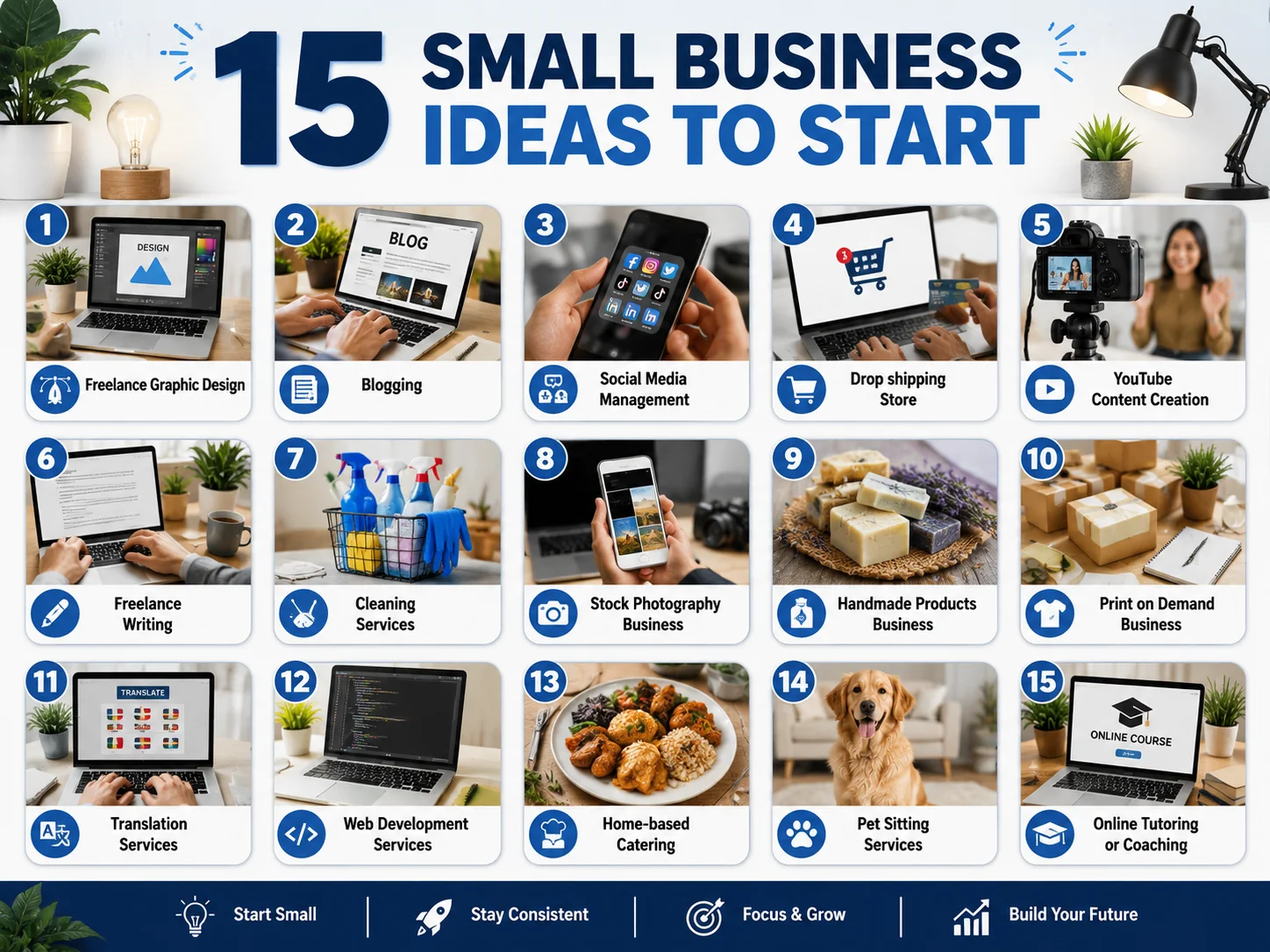
- The Full List: 15 Small Business Ideas With No Money Required
- Comparison Table: All 15 No-Money Small Business Ideas Side by Side at a Glance
- How to Choose the Right No-Money Small Business Idea for You
- Step-by-Step: Launching Your No-Money Small Business This Week
- Free and Low-Cost Tools for These Small Business Ideas
- How to Get Your First Customer for Any of These Small Business Ideas
- What Reddit Entrepreneurs Say About Starting a Small Business With No Money
- Common Mistakes That Sink No-Money Small Business Startups
- Real Small Business Founder Stories: Built From Nothing
- When (and How) Your Small Business Should Start Spending Money
- Frequently Asked Questions About Small Business Ideas
- Final Thoughts on Small Business Ideas With No Money
1. Introduction: Are Small Business Ideas With No Money Realistic?

Yes — and it’s more achievable today than at almost any point in business history. Starting one of these small business ideas with no money requires zero financial capital, but it demands a significant investment of time, effort, and resourcefulness instead (Forbes Advisor, 2026). The myth that you need a hefty bank loan or angel investor to get started has kept countless capable people on the sidelines, when in reality, the best business to start with no money is the one you can actually launch this week using skills you already have.
This guide pulls together research and reporting from five of the most trusted business publications — Forbes, Entrepreneur, NerdWallet, Business.com, and Harvard Business Review — to give you 15 small business ideas with no money required, along with the exact steps founders have used to take them from zero to their first paying customer.
Key takeaway: A budget of $0 doesn’t mean a strategy of $0. The small business ideas that succeed with no money are still built on real validation, real skills, and real customer outreach — they just skip the spending that doesn’t directly generate revenue.
2. The Bootstrapping Mindset Behind Successful Small Business Ideas

Before diving into specific small business ideas with no money, it helps to understand the bigger philosophy behind starting your small business lean, since it shapes nearly every decision you’ll make in your first few months.
Bootstrapping isn’t a consolation prize — it’s a strategy
Bootstrapping describes a situation in which an entrepreneur starts a company with little capital, relying on personal finances or operating revenue rather than outside investment, and research increasingly frames this as a deliberate strategic choice rather than simply a lack of options (Entrepreneurship Theories, citing Bhide, Harvard Business Review, 1992). Far from being a sign of scarcity, choosing to self-fund and resource-minimize is often described as a strategic masterstroke that keeps founders focused on what actually generates revenue (Entrepreneurship Theories, 2026).
The data behind why bootstrapping works
Research from Harvard Business School lecturer Shikhar Ghosh found that roughly 75% of venture-backed companies in the U.S. never return cash to their investors, and 30–40% liquidate entirely — a sobering reminder that outside funding is not the safety net it appears to be (Founderpath, citing HBS research, 2026). Meanwhile, Gallup research shows that 77% of small business founders cite personal savings, not loans or investors, as their most common funding source (Founderpath, 2026).
Why this matters for your no-money business idea
Harvard Business School professor Noam Wasserman’s well-known “Rich Versus King” framework captures the trade-off directly: founders chasing rapid wealth typically need investors, which means giving up control, while founders who self-fund keep control but often grow more gradually (Entrepreneur, citing Wasserman, HBR research, 2026). For someone starting with no money, this isn’t a disadvantage — it’s already the default path, and one with a long track record of producing sustainable, founder-controlled businesses.
Human and social capital — your skills and your connections — are the primary drivers that allow one of these small business ideas to function when cash is tight, and strong personal networks have been shown to directly impact business performance by providing informal resources that money simply can’t buy (Entrepreneurship Theories, citing Jones & Jayawarna, 2010).
3. The Full List: 15 Small Business Ideas With No Money Required
Each of these 15 small business ideas can realistically be started with $0 in upfront capital, using tools, platforms, or skills that are either free or already in your possession.
At a glance, the 15 small business ideas covered below are: virtual assistant services, freelance writing, pet sitting and dog walking, tutoring, social media management, dropshipping, print-on-demand, digital products, freelance editing, influencer/content creation, bookkeeping, house cleaning, errand running, consulting, and online courses/coaching.
1. Virtual Assistant Services — One of the Best Small Business Ideas
Virtual assisting involves providing administrative, marketing, or tech support to busy professionals and entrepreneurs, and it’s one of the most flexible no-money business ideas because it can grow into a full-time business with recurring clients (Forbes Advisor, 2026). Service-based businesses like this are the fastest way to generate cash with no overhead, since your only real investment is your time and existing computer. It remains one of the most accessible small business ideas for total beginners.
Getting started: List your services on Upwork, Fiverr, or LinkedIn, and reach out directly to small business owners in your network who are likely overwhelmed with admin work. This is one of the most practical small business ideas to act on immediately.
2. Freelance Writing — One of the Best Small Business Ideas
If you have solid writing skills, freelance writing remains one of the most accessible small business ideas with no money, since clients range from individuals to non-profits, small business ideas, and larger corporations (LivePlan, 2026). Even with the rise of AI writing tools, organizations still need strong communicators who can effectively sort fact from misinformation and bring a genuine human voice to their content. It remains one of the most accessible small business ideas for total beginners.
Getting started: Build a small portfolio with two or three sample pieces, then pitch directly to local business blogs or list your services on a freelance marketplace. This is one of the most practical small business ideas to act on immediately.
3. Pet Sitting and Dog Walking — One of the Best Small Business Ideas
House- and pet-sitting are businesses you can start with zero dollars, making them some of the most accessible small business ideas with no money for beginners of any age (Shopify, 2026). A dog walking business in particular is profitable because your only real expense is your time and basic supplies, while still building transferable skills like client communication and scheduling (Tailor Brands, 2026). It remains one of the most accessible small business ideas for total beginners.
Getting started: Register on a dedicated pet-care app, advertise in local social media groups, and ask early clients for reviews to build trust quickly. This is one of the most practical small business ideas to act on immediately.
4. Tutoring and Online Teaching — One of the Best Small Business Ideas
Tutoring suits entrepreneurs looking for a low-investment business idea they can run from home, either as a side hustle or a full-time occupation, and subjects ranging from academic tutoring to second-language instruction are all viable starting points (Tailor Brands, 2026). You can teach individual students online or run group classes, scaling your income without scaling your costs. It remains one of the most accessible small business ideas for total beginners.
Getting started: Offer a free trial session to two or three students in your network, collect testimonials, then list your services on a tutoring marketplace or your own social media profile. This is one of the most practical small business ideas to act on immediately.
5. Social Media Management and Content Creation — One of the Best Small Business Ideas
Most businesses know they need online content, but many can’t afford a big agency — which creates real opportunity for solo operators using AI tools to generate blog posts, social captions, and newsletters, then applying their own human touch to refine the output (Accountability Now, 2026). This is a low-risk, high-demand service that works especially well for people who can write clearly and stay organized. It remains one of the most accessible small business ideas for total beginners.
Getting started: Target local small business ideas directly, offer to manage their content calendar for a flat monthly fee, and keep your pricing simple to win your first few clients quickly. This is one of the most practical small business ideas to act on immediately.
6. Dropshipping — One of the Best Small Business Ideas

Dropshipping is one of the most accessible ways to start one of these small business ideas without upfront capital, since you only pay for inventory after a customer makes a purchase, eliminating warehousing fees and large manufacturing costs entirely (Shopify, 2026). One successful dropshipping entrepreneur recommends starting with five to ten low-cost products alongside a simple storefront and a TikTok account focused on organic content rather than paid ads (Shopify, 2026). It remains one of the most accessible small business ideas for total beginners.
Getting started: Pick a tightly focused niche, set up a free or low-cost storefront, and validate demand with organic social content before spending anything on ads. This is one of the most practical small business ideas to act on immediately.
7. Print-on-Demand Products — One of the Best Small Business Ideas
Print on demand gives you the option to start a fashion or merchandise brand without paying for stock upfront, letting you test designs before committing any real capital (Shopify, 2026). If you’re not a designer yourself, you can hire one affordably from freelancer platforms and use free mockup templates instead of paying for a product photoshoot. It remains one of the most accessible small business ideas for total beginners.
Getting started: Design or commission a handful of products around a niche community or interest, list them through a free print-on-demand integration, and promote organically within that community. This is one of the most practical small business ideas to act on immediately.
8. Digital Products (Templates, Printables, E-books) — One of the Best Small Business Ideas
Creating and selling digital products requires little more than an internet connection, since you develop helpful content once and package it into templates, printables, or guides that can be sold repeatedly with no per-unit cost (Shopify, 2026). This high-margin small business idea is especially well suited to people who already have expertise others are actively searching for. It remains one of the most accessible small business ideas for total beginners.
Getting started: Identify a specific, recurring question people in your niche ask, build a simple digital resource that answers it, and list it on a marketplace like Etsy or your own storefront. This is one of the most practical small business ideas to act on immediately.
9. Freelance Editing and Proofreading — One of the Best Small Business Ideas

As long as there is written content, there will be a continued need for skilled editors who can effectively sort facts from misinformation, even in an era of widespread AI writing tools (LivePlan, 2026). If you have strong writing experience and a sharp eye for detail, freelance editing is a genuinely low-barrier small business idea you can start immediately. It remains one of the most accessible small business ideas for total beginners.
Getting started: Offer a discounted first edit to two writers or small business ideas in exchange for a testimonial, then use that social proof to start charging full rates. This is one of the most practical small business ideas to act on immediately.
10. Influencer and Content Creator Business — One of the Best Small Business Ideas
Becoming an influencer is increasingly viable as a free business opportunity, since getting started requires nothing more than a smartphone and active social media accounts (LivePlan, 2026). Success comes from consistently creating engaging content that resonates with a specific niche audience — beauty, fitness, travel, food, or any other defined community — rather than trying to appeal to everyone at once. It remains one of the most accessible small business ideas for total beginners.
Getting started: Pick one platform and one specific niche, post consistently for 60–90 days, and track which content formats earn the most genuine engagement before exploring monetization. This is one of the most practical small business ideas to act on immediately.
11. Bookkeeping and Tax Preparation Services — One of the Best Small Business Ideas
At some point, most small business ideas seek the advice of a good bookkeeper, whether to prepare for tax season or simply plan for the future — and if you’re already trained or willing to pursue the relevant credentials, this is a genuinely high-demand small business idea with low overhead (Entrepreneur, 2026). Many tax preparation paths offer courses and training that let you get up to speed without large upfront tuition costs. It remains one of the most accessible small business ideas for total beginners.
Getting started: Start with simple bookkeeping for one or two small local businesses, building real-world experience while you pursue any additional credentials you may need. This is one of the most practical small business ideas to act on immediately.
12. House Cleaning Services — One of the Best Small Business Ideas
Service-based businesses like cleaning are typically the quickest to launch, since they require no upfront inventory investment beyond basic supplies many people already own (Business.com, 2026). This remains one of the most reliable small business ideas with no money because demand is consistent and word-of-mouth referrals can sustain a full client roster without any advertising spend. It remains one of the most accessible small business ideas for total beginners.
Getting started: Offer a discounted first cleaning to neighbors or friends, ask for reviews and referrals immediately, and gradually raise your rates as your schedule fills. This is one of the most practical small business ideas to act on immediately.
13. Errand Running and Personal Concierge Services — One of the Best Small Business Ideas
Choosing a service business if you need cash this week is a common recommendation for first-time founders, and errand running fits that need directly, since it can generate income within three to seven days with no tools, inventory, or special equipment required (Home Base, 2026). This small business idea works particularly well in busy urban areas or communities with a large population of older residents or busy professionals. It remains one of the most accessible small business ideas for total beginners.
Getting started: Post in local community groups listing five specific tasks you can help with this week, and focus on building a reliable reputation before expanding your service list. This is one of the most practical small business ideas to act on immediately.
14. Consulting in Your Area of Expertise — One of the Best Small Business Ideas
If you have knowledge and skills others can benefit from, launching a consultancy lets you guide, advise, and mentor others — and consultancies often start small before growing into reputable, mid-sized firms over time (Business.com, 2026). Unlike many small business ideas, consulting can command premium rates immediately if you have genuine, demonstrable expertise in a specific industry or skill. It remains one of the most accessible small business ideas for total beginners.
Getting started: Offer a free or heavily discounted strategy session to a handful of contacts, document the results, and use those outcomes as proof points for paid engagements. This is one of the most practical small business ideas to act on immediately.
15. Online Courses and Coaching — One of the Best Small Business Ideas
If your friends, family, or colleagues frequently ask you similar questions, that recurring pattern is often a strong signal your knowledge has the potential to become a lucrative course (Foundr, 2026). Coaching and course creation can scale almost infinitely once built, since the same content or framework can serve one client or a thousand without significantly increasing your costs. It remains one of the most accessible small business ideas for total beginners.
Getting started: Validate your course topic by offering a live, low-cost workshop first, then turn the most popular sections into a structured, repeatable digital course. This is one of the most practical small business ideas to act on immediately.
4. Comparison Table: All 15 No-Money Small Business Ideas Side by Side at a Glance
| # | Small Business Idea | Time to First Dollar | Core Skill Needed | Scalability |
|---|---|---|---|---|
| 1 | Virtual Assistant | 1–2 weeks | Organization, communication | Medium |
| 2 | Freelance Writing | 1–4 weeks | Writing | Medium |
| 3 | Pet Sitting/Dog Walking | 3–7 days | Reliability | Low–Medium |
| 4 | Tutoring | 1–2 weeks | Subject expertise | Medium |
| 5 | Social Media Management | 2–4 weeks | Content + AI tools | Medium–High |
| 6 | Dropshipping | 2–6 weeks | Marketing, niche research | High |
| 7 | Print-on-Demand | 2–6 weeks | Design or curation | Medium–High |
| 8 | Digital Products | 4–8 weeks | Subject expertise | High |
| 9 | Freelance Editing | 1–3 weeks | Attention to detail | Medium |
| 10 | Influencer/Content Creator | 60–90+ days | Consistency, niche focus | High |
| 11 | Bookkeeping | 2–6 weeks | Numbers, accuracy | Medium |
| 12 | House Cleaning | 3–7 days | Reliability | Low–Medium |
| 13 | Errand Running | 3–7 days | Reliability, local network | Low |
| 14 | Consulting | 1–3 weeks | Deep expertise | Medium–High |
| 15 | Online Courses/Coaching | 4–12 weeks | Teaching, packaging | High |
5. How to Choose the Right No-Money Small Business Idea for You

With 15 different small business ideas on the table, the right starting point depends on three honest questions.
Do you need cash this week or can you wait?
Choose a service business if you need cash this week — dog walking, cleaning, tutoring, and errand running can generate income in three to seven days (Home Base, 2026). Choose an online or digital business if you can wait 30–60 days, since digital products, affiliate marketing, and content creation take longer to build momentum but scale far better over time (Home Base, 2026).
What skills do you already have?
The best businesses to start without money are personal services and digital products, neither of which has high startup costs, and both of which work best when built around skills you already possess rather than ones you’d need to learn from scratch (QuickBooks, 2026).
How much risk tolerance do you have?
Service-based businesses generally offer faster, more predictable income with a lower ceiling, while digital products, content creation, and dropshipping carry a longer runway to first revenue but considerably more upside once they gain traction.
Quick answer box: If you need money fast, start with a service business (pet sitting, cleaning, tutoring, virtual assisting). If you can invest in slower growth for bigger long-term upside, start with a digital, content, or dropshipping business instead.
6. Step-by-Step: Launching Your No-Money Small Business This Week
Knowing which small business ideas to start with no money is just the beginning — here’s exactly how to go from idea to a first paying customer (Home Base, 2026).
Step 1: Pick One Small Business Idea Today
The mistake most people make is trying to start three businesses at once. Focus beats hustle every time — master one revenue stream before adding another (Home Base, 2026).
Step 2: Launch Your No-Money Business With What You Already Have
Spend money only on things that directly generate revenue. A fancy website, business cards, or professional headshots can all wait until after you have paying customers (Home Base, 2026).
Step 3: Tell 20 People About Your Small Business This Week
Let friends, family, and your existing network know what you’re building, and share it through your personal social accounts, local community groups, and any relevant hobby or professional groups you’re already part of (Forbes, 2026).
Step 4: Make an Irresistible First Offer for Your Small Business
Your first few customers can receive a discount in exchange for an honest testimonial. After that, charge what you’re worth — underpricing indefinitely tends to attract the least loyal, highest-maintenance customers (Home Base, 2026).
Step 5: Ask Your Small Business’s First Customers for Reviews
As customers roll in, gathering reviews or testimonials early creates the social proof you’ll need to raise your prices and attract better-fit clients going forward (Forbes, 2026).
Step 6: Reinvest Your Small Business Earnings, Don’t Hoard
Once your first dollars come in, reinvest in tools or upgrades that save time or improve customer experience — small, compounding improvements beat one large purchase made too early (Home Base, 2026).
Actionable checklist:
- [ ] Chosen one specific business idea from the 15 above
- [ ] Listed the free tools and skills you already have
- [ ] Told at least 20 people in your network this week
- [ ] Created a first-customer offer or discount
- [ ] Set up one free profile, listing, or storefront
- [ ] Asked your first customer for a review or referral
7. Free and Low-Cost Tools for These Small Business Ideas
You don’t need to pay for software to launch any of these 15 small business ideas. Many areas now offer online resources that walk founders through registration step by step at no cost, and the total legal setup typically runs under $500 even for most small service businesses (Business.com, 2026).
- Canva — free graphic design for social posts, digital products, and simple branding
- ChatGPT or Claude — drafting content, business plans, and customer communications
- Google Forms — collecting customer feedback and validating demand before you build anything
- Upwork, Fiverr, and Freelancer — finding your first clients without any marketing spend
- Free accounting software — tracking income and expenses from day one without a paid subscription
- SCORE — free mentoring and resources from the Service Corps of Retired Executives (Bank of America, 2026)
8. How to Get Your First Customer for Any of These Small Business Ideas
Getting your first customer is the step that intimidates most beginners, but it follows a repeatable pattern across nearly every successful no-money launch.
Start with your existing network
The easiest people to reach when you have no marketing budget are those already in your network — updating your LinkedIn profile and reaching out personally costs nothing but consistently produces one of these small business ideas’s first few sales (Bank of America, 2026).
Use free online communities strategically
Sites like Facebook and Reddit host active communities that can point new founders toward free and low-cost tools and potential customers alike, provided you participate genuinely rather than only posting promotional links (QuickBooks, 2026).
Validate before you build anything bigger
Use free validation methods such as customer interviews, social media surveys, and pre-order landing pages, with tools like Google Forms helping you gather feedback before investing real time in a fuller build-out (Business.com, 2026).
Take pre-orders when possible
You can place a picture of your product idea on social media, drive traffic to it with inexpensive or free promotion, and take pre-orders through a simple e-commerce tool — using that early revenue to fund your first real production run rather than the other way around (Bank of America, 2026).
9. What Reddit Entrepreneurs Say About Starting a Small Business With No Money
Beyond official publications, broader founder communities — including small business and entrepreneurship discussions on Reddit and similar forums — consistently echo several of the same hard-won lessons found in this guide.
Service businesses dominate the “start this week” advice. Across founder communities, the recurring consensus is that service-based work (cleaning, tutoring, pet care, freelance writing) remains the fastest, most reliable path to a first dollar with zero capital, mirroring the guidance from Home Base and Forbes covered above.
Consistency beats intensity. A frequently repeated sentiment across founder forums is that steady, incremental effort over months consistently outperforms short, intense bursts of activity followed by long gaps — directly echoing the bootstrapping research on consistency cited earlier in this guide.
Underpricing is a recurring regret. Founders across these communities frequently flag underpricing their first offers as one of their biggest early mistakes, since it attracts less committed customers and makes one of these small business ideas harder to sustain once real costs appear.
Free communities themselves are a resource. Sites like Facebook and Reddit host genuine communities that can point founders toward free tools, peer accountability, and even early customers, making these platforms doubly useful — both as a place to learn and a place to launch (QuickBooks, 2026).
10. Common Mistakes That Sink No-Money Small Business Startups
- Waiting for the “perfect” idea instead of starting. There’s no perfect business — only the business you start and improve over time (Home Base, 2026).
- Trying to start three businesses at once. Spreading effort across multiple ideas at launch routinely produces weaker results than focusing fully on one (Home Base, 2026).
- Spending on things that don’t generate revenue. Skip the polished website, business cards, and professional photos until paying customers justify the cost (Home Base, 2026).
- Underpricing indefinitely. A discount for your first testimonials is smart; giving away your work forever is not (Home Base, 2026).
- Giving up before month three. Most businesses don’t hit their stride until month two or three, and quitting earlier is one of the most common — and most avoidable — failure points (Home Base, 2026).
- Skipping validation entirely. Building a full product before confirming real demand wastes the one resource a no-money founder can’t easily replace: time.
- Ignoring your existing network. The fastest, lowest-cost path to a first sale is almost always people who already know and trust you, not cold strangers on the internet.
11. Real Small Business Founder Stories: Built From Nothing
Alicia Ho — Precious Ones Photography
Alicia Ho started her photography business with a $0 investment after friends and family took notice of her work, eventually building enough of a client base to qualify for one of these small business ideas loan from a local nonprofit once she was ready to scale (Shopify, 2026).
Remi Martins — Regirl
After developing her product with a hair stylist, Remi Martins tested demand through pre-orders before investing any real capital, selling 50 products in the first 60 days before eventually putting $1,000 into inventory and marketing (Shopify, 2026).
Luisa Zhou — Coaching Business
Business strategist Luisa Zhou earned her first $20,000 in coaching revenue without ever building a website, relying instead on direct outreach and word of mouth to validate and grow her offer (Forbes Advisor, 2026).
Kristen Pumphrey — P.F. Candle Co.
Kristen Pumphrey began P.F. Candle Co. as a DIY business making candles in her own apartment, proving that even physical product businesses can start with minimal upfront investment when scaled carefully (Shopify, 2026).
Pattern across these stories: None involved outside investment at launch. Each relied on validating demand first, using personal networks for early traction, and reinvesting earnings rather than borrowing against future growth.
12. When (and How) Your Small Business Should Start Spending Money
Eventually, even a no-money business will need some capital to grow — but that capital should come after demand is proven, not before.
Reinvest before you borrow
As your business earns more, set aside as much as possible and reinvest it directly into growth, eventually building toward larger expansions only once the business has proven it can sustain itself (Business.com, 2026).
Explore non-dilutive funding first
Crowdfunding platforms validate demand and raise funds simultaneously, while grants — especially for women, minority, or veteran-owned businesses — are available through local and national programs without requiring you to give up equity or take on debt (Forbes Advisor, 2026).
Trade skills before paying cash
You can trade services with a designer, marketer, or developer to get what you need before you have any real revenue, a strategy that costs nothing but your own time and expertise (Forbes Advisor, 2026).
Use revenue-based tools when ready
Tools like business credit cards can serve as short-term financing to purchase necessary supplies while cash flow is still shaky, provided you spend within your limit and pay the balance in full each month to avoid a debt cycle (NerdWallet, 2026).
13. Frequently Asked Questions About Small Business Ideas
1. Can you really start one of these small business ideas with no money? Yes — starting one of these small business ideas with no money requires zero financial capital but demands significant time, effort, and resourcefulness, and many successful entrepreneurs have built profitable businesses this way (Forbes Advisor, 2026).
2. What is the easiest small business idea to start with no money? Service-based businesses like pet sitting, house cleaning, tutoring, and errand running are generally considered the easiest, since they can generate income within three to seven days with no inventory or special equipment (Home Base, 2026).
3. How long does it take to make money with small business ideas that require no money? Service businesses can generate a first dollar within a week, while online and digital businesses like content creation or digital products typically take 30–90 days to gain real traction (Home Base, 2026).
4. Do I need a business plan to start small business ideas with no money? A formal business plan is helpful, especially if you’ll eventually seek funding, but many successful no-money founders start with a simple offer and a clear first-customer plan rather than a lengthy formal document.
5. What’s the biggest mistake people make starting one of these small business ideas with no money? Trying to launch multiple business ideas simultaneously instead of focusing on one until it gains real traction is among the most commonly cited mistakes (Home Base, 2026).
6. Can digital product small business ideas really be profitable with no upfront investment? Yes — digital products are highly scalable since you create them once and can sell them repeatedly with no per-unit cost, making them one of the highest-margin no-money business ideas available (Shopify, 2026).
7. Should I register an LLC before testing small business ideas with no revenue? Not necessarily right away. Many founders start informally and formalize their business structure once revenue justifies the cost, though total legal setup for most small service businesses typically runs under $500 (Business.com, 2026).
8. Is bootstrapping small business ideas better than raising venture capital? For most small business ideas, yes. Roughly 75% of venture-backed companies never return cash to investors, while bootstrapped founders maintain full control and can grow at a sustainable pace (Founderpath, citing HBS research, 2026).
9. How do I get my first customer for small business ideas with zero marketing budget? Start by telling your existing network, joining relevant free online communities, and offering a discounted first engagement in exchange for an honest testimonial (Forbes, 2026; Bank of America, 2026).
10. When should I start spending money on my small business ideas? Once you’ve validated demand and have real revenue coming in, reinvest those earnings into tools or upgrades that directly improve customer experience or save you time, rather than spending speculatively before you have customers (Business.com, 2026).
14. Final Thoughts on Small Business Ideas With No Money
Starting one of these small business ideas with no money isn’t a compromise — for the majority of successful founders, it’s simply how real businesses get built. The data backs this up directly: 77% of founders cite personal savings as their primary funding source, and three-quarters of venture-backed companies never return cash to their investors in the first place (Founderpath, 2026).
Whether you choose virtual assisting, freelance writing, pet sitting, dropshipping, or any of the other small business ideas covered in this guide, the path forward looks the same: pick one idea, use only what you already have, tell your network this week, and get your first paying customer before you spend a single dollar on anything that doesn’t directly generate revenue.
Conclusion: Your Next Small Business Ideas Journey Starts Today
These 15 small business ideas with no money prove that a thin wallet isn’t the barrier most people assume it is — skill, consistency, and a willingness to start before everything feels perfect matter far more than a funding round ever could. Pick the small business idea from this list that best matches your skills and timeline, take the first concrete step today, and let your first few paying customers — not a business plan sitting in a drawer — tell you whether your small business is worth scaling further.
(Internal link suggestion: link “freelance writing” and “digital products” above to your existing online business and AI tools guides so readers researching one topic naturally discover the other.)
About This Guide
This guide was researched and compiled using reporting and data from Forbes, Forbes Advisor, Entrepreneur, NerdWallet, Business.com, and Harvard Business Review, along with supplementary research from Shopify, QuickBooks, Bank of America, and Founderpath. Every statistic and founder example is sourced and linked below. This guide is reviewed periodically to reflect current tools, platforms, and startup costs.
Sources Referenced for These Small Business Ideas
- Forbes Advisor — “How to Start a Business With No Money”
- Entrepreneur — “73 Small Business Ideas to Start in 2026”
- Entrepreneur — “Starting a Business? Before You Seek VC Money, Here’s Why Bootstrapping May Be the Better Choice”
- NerdWallet — “How to Start a Business in 15 Steps”
- Business.com — “You Can Start a Business With as Little as $0”
- Harvard Business Review — “Why Every Startup Should Bootstrap”
- Shopify — “How to Start a Business with No Money in 7 Steps”
- Shopify — “72 Small Business Ideas to Start in 2026”
- LivePlan — “30 Businesses You Can Start for Free in 2026”
- Home Base — “How to Start a Business With No Money (Guide)”
- Bank of America — “How to Start a Business with Little or No Money”
- QuickBooks — “How to Start a Business With No Money”
- Foundr — “9 Best Businesses You Can Start with No Money”
- Tailor Brands — “41 Small Business Ideas to Start in 2026”
- Founderpath — “Bootstrapping a Startup: Complete Guide for SaaS Founders”